❤️ For Mother's & Father's Day, we're giving you €75 with the code: WISH75 – only until May 17. to the Shop

Understanding and Tracking My Cycle

Your cycle involves much more than just the time between two periods. Hormonal processes influence it in many ways and determine your fertile days. To your  Gaining a Better Understanding of Menstrual Health To optimize your fertility, it helps to closely monitor your cycle—for example, using a medically approved method like OvulaRing.

Learn more about your cycle—for a better sense of your body

Your cycle is so much more than just the time between one period and the next! To better understand your cycle, you should therefore familiarize yourself with the the actual processes in your body deal with.

Menstrual bleeding is perhaps the most obvious, but it is just one of the effects of the hormonal changes that occur during the cycle. These changes are quite varied and may be subject to fluctuations or be influenced by.

In other words, this means that the natural interplay of your hormones to the fact that in every new cycle fertile days can happen. But how well do you really understand the processes involved in your own cycle? What can you do to support your cycle—for example, to improve your fertility?

To better understand your cycle, you should keep a close eye on it. A good starting point for this is the detailed tracking of your cycle using a medically approved method such as OvulaRing.

Understanding and Tracking My Cycle

The Female Cycle: A Brief Introduction

What is the menstrual cycle?

The menstrual cycle begins on the first day of a woman’s period and ends on the day before the next period begins. The cycle is largely regulated by female sex hormones (e.g., estrogen, progesterone). In addition to menstruation, there are a variety of signs associated with the menstrual cycle, including a rise in body temperature around the time of ovulation.

How similar are menstrual cycles among different women?

Menstrual cycles can vary greatly from woman to woman. For one thing, the length of the cycle varies from woman to woman. For another, a woman’s cycles can also fluctuate significantly from one month to the next. This is referred to as a irregular cycle. There are also others Cycle Typesthat can help you better understand your cycle. Track your cycle and ovulation now with our Online Ovulation Calculator.

What factors influence the female menstrual cycle?

Stress is certainly one of the biggest factors that can affect the menstrual cycle. An unhealthy diet and too little or too much physical activity can also contribute to this. In addition, extreme physical exertion, psychological stress, and various medical conditions can play a role.

[ovu_output_schema_faqf1 = "What is the female cycle?​​"a1 = "The female cycle begins on the first day of menstruation and ends on the day before the next period begins. The cycle is largely regulated by female sex hormones (e.g., estrogen, progesterone). In addition to menstruation, there are a variety of signs in the female cycle, including a rise in body temperature around the time of ovulation."f2 = "How similar are cycles among different women?"a2 = "The processes within the cycle can vary greatly from woman to woman. On the one hand, cycle length varies from woman to woman. On the other hand, a woman’s cycles can also vary significantly from one to the next. This is referred to as an irregular cycle. There are also other cycle types that can help you better understand your cycle."f3 = "What influences the female cycle?"a3 = "Stress is certainly one of the biggest factors that can influence the cycle. An unhealthy diet, too little or too much physical activity can also contribute to this. Furthermore, extreme exertion, psychological stress, and various medical conditions can play a role."]

Understand and track your cycle completely—with OvulaRing

OvulaRing can help you gain a better understanding of your cycle. It does this by tracking your entire cycle and identifying your cycle patterns. This allows you to understand exactly what’s happening during your cycle and determine whether your cycles are healthy and fertile. You can also identify any signs of a hormonal cycle disorder.

How regular or irregular are your cycles, though? What do the lengths of the two phases of your cycle tell you, for example? How can I tell if my cycle is healthy and fertile? You’ll find the answers to these questions here. This will help you finally understand your cycle and gain valuable insights for yourself.

What happens during my menstrual cycle?

It all starts in the mind

Your menstrual cycle is regulated by a complex interplay of hormones. In fact, the maturation of the egg is initiated by signals from specific hormones. It all starts in the brain—more specifically, in the hypothalamus.

This is where the hormone that is important for the cycle is produced Gonadotropin-Releasing Hormone (GnRH) is produced. This hormone sends important signals to the pituitary gland, for example. As a result, the pituitary gland produces follicle-stimulating hormone (FSH) and luteinizing hormone (LH).

These hormones then send signals to the ovaries, triggering egg maturation and ovulation. The pituitary gland is a very sensitive part of our brain. It reacts, for example, to stress of any kind and controls the autonomic nervous system. When the body experiences stress, hormone production is disrupted accordingly. This can ultimately lead to a wide variety of hormonal imbalances and menstrual cycle problems.

Menstrual Cycle Phases and Hormones

The following hormones play a crucial role in the female cycle:

It is generally assumed that a healthy female cycle lasts 28 days and involves ovulation in the middle of the cycle. However, this so-called standard cycle applies to just 4% of all women. The vast majority of women have significantly longer or shorter cycles, and ovulation does not occur in the middle of the cycle. But these cycles can also be healthy. We can roughly divide a healthy cycle into two phases, and upon closer examination, even into divide into four phases:

A new cycle always begins on the first day of your period. Bleeding is triggered by a drop in estrogen and progesterone levels. The uterine lining sheds because a fertilized egg has not implanted. All four hormones that influence the cycle (FSH, LH, estrogen, and progesterone) are at their lowest levels at this point. This can result in bleeding of varying intensity.

Heavy bleeding can be caused by conditions such as PCOS, endometriosis, or a thyroid disorder. Spotting—that is, brownish discharge—is not considered part of your period. During your period, approximately 50–100 ml of blood is shed along with the uterine lining. A normal menstrual period usually lasts three to seven days.

During this phase, our brain releases increased levels of follicle-stimulating hormone
(FSH).

This stimulates the maturation of approximately 40 to 100 follicles in our ovaries. The follicles produce estrogens, specifically the female sex hormone estradiol. Typically, only one of the follicles develops into a mature follicle ready for ovulation. The others usually regress, unless there is a hormonal disorder such as PCOS.

Shortly before ovulation, increased estrogen secretion triggers a rapid surge in luteinizing hormone (LH). The length of this phase of the cycle can vary greatly and ultimately affects the total length of the cycle. In cases of hormonal cycle disorders such as PCOS, this phase can sometimes be extremely long (> (30 days).

As estrogen levels in the blood rise, our brain receives a signal to release luteinizing hormone (LH). Together with the already elevated progesterone, LH triggers ovulation. A mature egg is released from the follicle in the ovary and travels into the fallopian tube. The shell of the egg (consisting of supporting cells) remains behind as the corpus luteum. An egg remains capable of being fertilized for about 12 to 24 hours after ovulation.

The egg now travels through the fallopian tubes toward the uterus. The corpus luteum that remains begins to produce the hormone progesterone. Some estrogen is also still produced. Ideally, however, progesterone should be the dominant hormone during this phase of the cycle. Progesterone ensures that the uterine lining is optimally built up and “softened” so that the fertilized egg can implant properly. As progesterone is released, our body temperature also rises by approximately 0.25 to 0.5°C. This is why this phase of the cycle is characterized by a temperature peak.

If your temperature remains elevated for at least 3 days, you can be sure that ovulation has occurred. If the egg is not fertilized, the corpus luteum begins to break down and gradually stops producing progesterone (and estrogen). If a fertilized egg has successfully implanted, the corpus luteum remains intact for about three months. After that, the placenta takes over hormone production.

The length of the luteal phase is fairly consistent and should ideally last 12–16 days. If this phase of the cycle is consistently shorter than 12 days, it could indicate luteal phase deficiency, which typically prevents a fertilized egg from implanting and may be a cause of infertility. If this phase lasts longer than 18 days, pregnancy is highly likely.

OvulaRing receives German Health Award 2024

For the third time in a row, OvulaRing has received the coveted award in the “Cycle Tracker/Computer” category. We are grateful for the award and proud of what we have already achieved with OvulaRing.

How is my menstrual health?

To understand your cycle, you’ll need a few details. A healthy cycle, for example, includes ovulation, a luteal phase that lasts 12–16 days, and a regular menstrual period. The total length of the cycle is less important as long as the other factors are in place. To find out if your cycle is healthy, you should monitor it closely and determine whether:

OvulaRing can help you track your cycle in detail. You can see if you’re ovulating and, if so, even when it happens. You’ll also receive information on whether your luteal phase is long enough. Plus, you can find out which external factors are affecting your cycle. This allows you to take targeted steps to stabilize your cycle.

Calculate ovulation

There are a variety of rather inaccurate methods for calculating ovulation
Methods. Many of them are based on a single daily measurement and are very
prone to errors. That is why they are particularly suited for very disciplined
Suitable for women with a regular menstrual cycle and a healthy lifestyle.

Below is an overview of the different methods for determining when you ovulate:

Measuring basal body temperature

Body temperature reflects the hormonal changes in the female cycle. At the time of ovulation, the simultaneous release of the hormone progesterone causes your core body temperature to rise by 0.25 to 0.5°C. With the Measuring your basal body temperature in the morning You can also use your basal body temperature to determine when ovulation has occurred. To do this, you must take your temperature at the same time and in the same place every day. The most accurate temperature is your core body temperature, which can be measured orally, vaginally, or rectally. The data is then entered into a cycle chart, a cycle app, or a cycle computer. The results are plotted on a cycle chart, allowing you to see when your temperature rises. If your temperature remains elevated for at least 3 days, you can be sure that ovulation has occurred.

Measuring basal body temperature is prone to error

Determining ovulation by measuring basal body temperature is time-consuming and prone to error. To ensure accurate results, you should have slept for the same number of hours every night. In particular, an irregular lifestyle, shift work, travel, alcohol consumption, stress, and restless sleep—such as from children waking up or going to bed late—directly affect measurement accuracy and can very easily skew the results. In addition, women often feel stressed when they think about taking the morning measurement and are afraid of missing the right time. Therefore, this method of ovulation prediction is only suitable for very disciplined women with a regular lifestyle and a fairly regular cycle.

Track core body temperature

With OvulaRing, we’ve made temperature tracking more objective and simpler. You no longer have to remember to take your temperature every morning, record your readings, or interpret your temperature charts. Thanks to high-resolution measurements taken every 5 minutes—288 times a day—OvulaRing delivers precise results even with irregular cycles and lifestyles. Your temperature changes slightly even before ovulation. OvulaRing detects these changes and shows you when your chances of getting pregnant are highest.

Ovulation or LH tests

An ovulation test measures the level of luteinizing hormone (LH) in the urine. LH is released in greater quantities during the fertile phase and, in a healthy cycle, triggers ovulation through a sudden surge. LH is excreted in the urine. An ovulation test can then measure the concentration of LH in the urine. The test reacts to the rise in ovulation-triggering LH in the urine. Until now, it was assumed that the highest LH concentration, known as the LH surge, is reached about 24–36 hours before ovulation. So much for the theory. But be careful! An ovulation test that measures LH in urine cannot pinpoint the exact time of your ovulation.

Ovulation tests do not track your cycle

Scientists have demonstrated that a rise in LH levels in urine is not always followed by ovulation. On average, the LH peak occurred 1.2 days after ovulation, rather than before it, as previously assumed. In only 6% of cycles did the LH surge end before ovulation. In the overwhelming majority (94%), however, LH continued to rise after ovulation, and in 60% of cycles, it remained elevated for more than 3 days. Ovulation tests are also unsuitable for hormonal cycle disorders such as PCOS or early menopause. In these cases, the LH level is often persistently elevated, so that the ovulation test frequently remains positive throughout. For example, elevated LH concentrations can be observed in 60% of all women with PCOS. Therefore, it is often not possible to accurately determine ovulation using an ovulation test!

Ovulation tests aren’t very accurate

Women with long cycles need a lot of ovulation tests. Checking hormone levels every day is not only time-consuming, but also stressful and expensive! Your LH levels can fluctuate significantly even during the course of a normal day. Additionally, taking antibiotics, psychiatric medications, hormone therapy, or Hormone testing in urine alone is based on just one measurement point per day and does not provide a comprehensive overview of your cycle. To fully understand your individual cycle, continuous cycle monitoring is essential. OvulaRing measures your core body temperature around the clock, records 288 data points per day, and reliably indicates your fertility window and ovulation, regardless of how long your cycle is or whether you have a hormonal cycle disorder.

Period trackers and period calculators

There are a wide variety of different Period trackers and calculators on the market. Some track fertile days by measuring temperature—for example, on the arm, wrist, or vaginally. Others measure LH levels in urine, progesterone levels in saliva, or hormonal changes in exhaled breath. With some, your fertile days are displayed in an app; with others, they appear on the device itself.

No matter what type of tracker or computer you’re using, they all have the following in common: they rely solely on a single daily reading or an overnight measurement. This makes them prone to error and unable to continuously track your cycle. They cannot provide you with comprehensive information about your cycle health. All products available on the market are designed and tested only for standard cycles. 70% of all women whose cycles do not conform to the standard do not receive accurate information about their ovulation and fertility from these tools.

Assess your menstrual health

If you want to know whether your cycle is healthy, it’s not just important to track your ovulation—you also need to keep an eye on your overall cycle health. This is only possible through continuous cycle monitoring. OvulaRing automatically measures your core body temperature every 5 minutes—24 hours a day, 7 days a week. That’s why OvulaRing can detect your fertile days even if your cycles are extremely short, very long, or completely irregular. Additionally, OvulaRing helps you determine whether there are signs of a hormonal cycle disorder despite ovulation. And unlike other products on the market, OvulaRing is 3 independent medical studies It has also been tested on women with a wide variety of cycles and hormonal cycle irregularities, and is suitable for them as well for determining their fertile days.

Want to start understanding your cycle better right now? Then use our OvulaRing Online Ovulation Calculatorto determine your ovulation and cycle in advance.

Want to fully understand your cycle?

Find out how your cycle works! Are your cycles healthy and fertile? Are there any signs of a hormonal cycle disorder? OvulaRing is the perfect tool to help you with this.

What are menstrual cycle disorders?

Amenorrhea, oligomenorrhea, hypermenorrhea, and hypomenorrhea—what do these terms mean? They all have one thing in common: they are menstrual cycle disorders, deviations from a woman’s normal menstrual cycle. Menstrual cycle disorders are primarily characterized by the fact that menstrual bleeding no longer occurs in the usual way. Deviations can affect the length of the cycles as well as the heaviness and/or duration of the period.

Gynecologists distinguish between various types of menstrual disorders. In most cases, these disorders are caused by a hormonal imbalance. As you’ve probably noticed, most of these disorders end in “-menorrhea” (or “-menorrhoea”). This is due to the meaning of the word, as “menorrhea” is the Greek term for menstrual bleeding.

Do you know the most common menstrual cycle disorders?

  • If the cycle becomes longer or shorter, doctors refer to this as a menstrual irregularity.
  • Oligomenorrhea: The menstrual cycle lasts longer than 35 days.
  • Polymenorrhea: The menstrual cycle shortens to less than 21 days

If the intensity or duration of the period changes, this is referred to as a “typical disorder.”

  • Hypermenorrhea: Menstrual flow is very heavy; affected women use more than 5 tampons or pads per day.
  • Hypomenorrhea: Menstrual flow is very light; those affected use fewer than 2 tampons or pads per day.
  • Menorrhagia: This refers to unusually long menstrual periods that last more than 7 days.
  • Brachymenorrhea: This refers to shorter menstrual periods that last less than 3 days.


Spotting or breakthrough bleeding is also considered a type of menstrual irregularity. This can occur before or after the actual period. A special form of this is Implantation bleeding which occurs in some women shortly after ovulation and is caused by the implantation of the fertilized egg into the uterine lining.

If a woman’s period stops completely, doctors refer to this as amenorrhea. This can be natural and harmless, such as during pregnancy or breastfeeding, or after menopause. However, there are also forms of amenorrhea that may indicate disorders or medical conditions:

  • Primary amenorrhea: This condition occurs when a girl has not started her period by the age of 16. By the way: Gynecologists refer to a young girl’s first period as menarche.
  • Secondary amenorrhea: A woman has been having her period, but then it suddenly stops for three months or more.

Often, the Oligomenorrhea (long intervals between periods) progresses to amenorrhea (absence of periods). This means that the intervals between periods become increasingly longer until they eventually stop altogether. Conversely, however, oligomenorrhea can also be a sign that the cycle is resuming after a prolonged pause.

You should see a doctor if…

  • you are over 16 years old and have not yet started your period.
  • Your period hasn’t come, even though you’re not pregnant or breastfeeding.
  • the intervals between your periods become consistently shorter or longer.
  • your bleeding is so heavy or lasts so long that it causes you distress or weakens your body.
  • you experience severe pain before and during your period.
  • you’re experiencing bleeding again, even though you’ve already gone through menopause.

There are many factors that can disrupt hormonal balance. Mental and physical stress, poor diet, delayed follicular maturation, luteal insufficiency, fibroids, endometriosis, estrogen deficiency, serious illness, etc. All of these can be potential causes of menstrual cycle irregularities. Therefore, it is always very important to have your doctor identify the specific cause of your menstrual cycle irregularity and treat it.

With OvulaRing Your cycle is recorded in its entirety and completely unnoticed, essentially being “tracked.” This allows you to determine, regardless of your menstrual flow, whether your cycles are healthy or if there are signs of a hormonal cycle disorder. You can also compare individual cycles at a glance and note any details in your cycle diary. Additionally, you have the option to request a free cycle consultation. Our cycle experts will review your recorded cycles and provide you with an assessment of your cycle health! This also helps your doctor with diagnosis and treatment.

Personal Cycle Analysis

You are already OvulaRing Manual and want to understand your cycle even better? Then you can use the form below to request a free personalized cycle analysis. Our experts will review the cycles you’ve tracked so far and provide you with an assessment of your cycle health.

Understand your cycle with OvulaRing

OvulaRing vaginal
1

Wear the OvulaRing

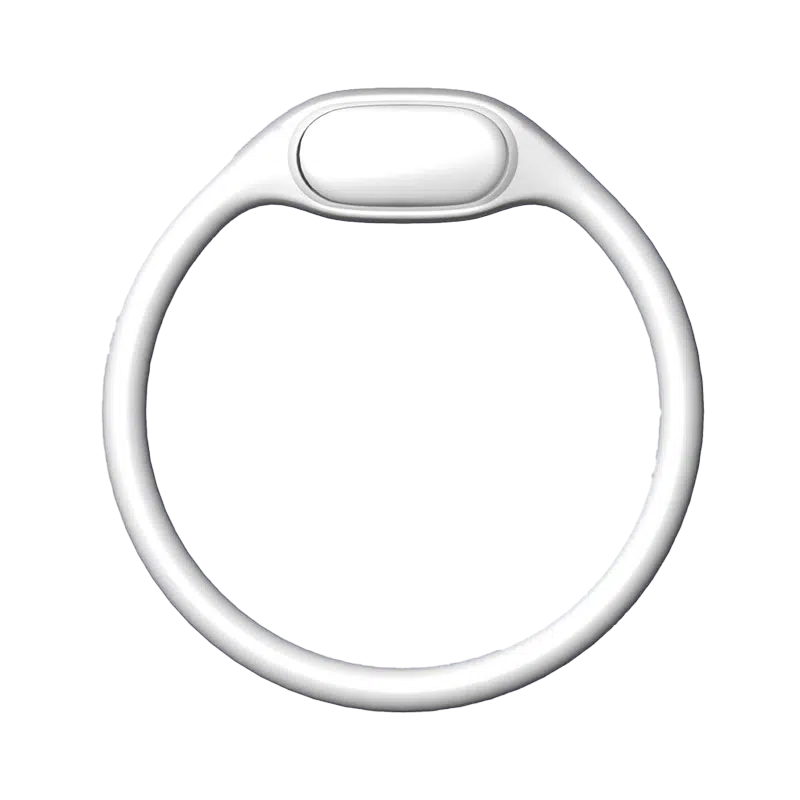
OvulaRing is inserted into the vagina immediately after your period, worn throughout your entire cycle, and removed only to transfer the data. Once inside your body, OvulaRing automatically measures and records your core body temperature every 5 minutes. You won’t even notice it’s there, so you can continue with all your usual activities and enjoy life as usual.


OvulaRing has no side effects and has been tested for good tolerability as part of its approval as a medical device.

2

Transfer data to the app

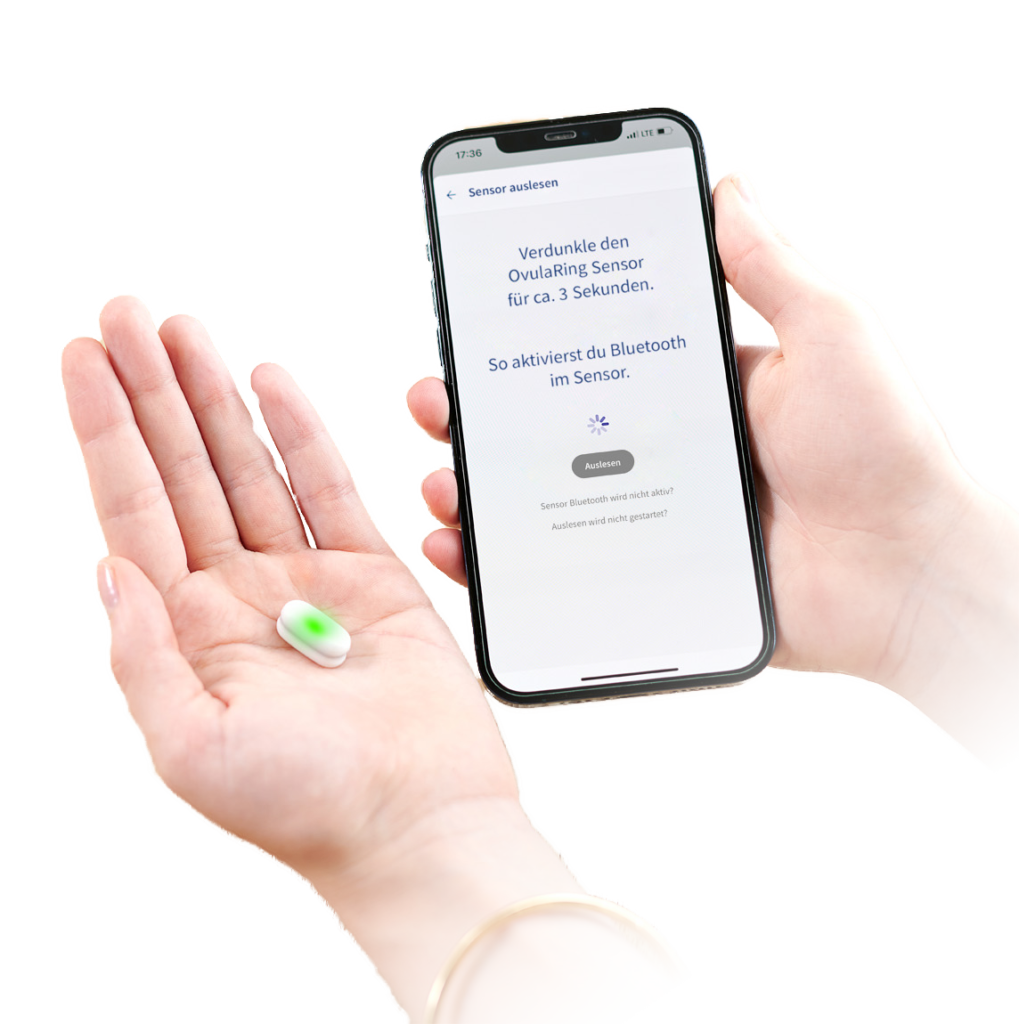
To transfer the data, remove the OvulaRing. Once outside the body, the sensor automatically switches to Bluetooth mode and sends your temperature data to the app in encrypted form. Your data is fully secured at all times and cannot be accessed by third parties. After the data is transferred, simply put the OvulaRing back on. You decide how often you want to transfer the data.

For natural birth control, we recommend removing the OvulaRing every day and syncing your data until the app tells you that your fertile days for this cycle are over.

OvularRing Datenübertragung
OvulaRing App Kurve
3

Track your cycle in the app

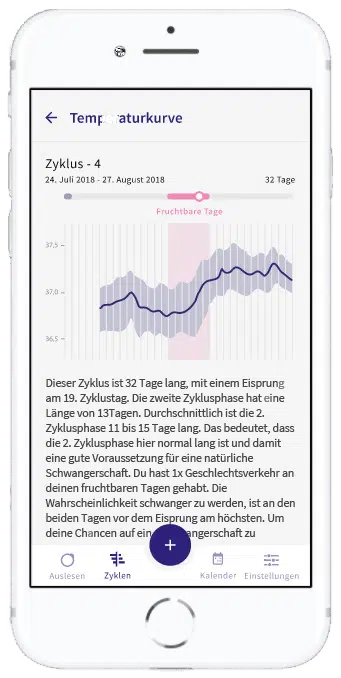
In the app or web-based software, you can view all the important information about your cycle. During your first cycle, OvulaRing gets to know you. You’ll find out exactly when you ovulated. Starting with your second cycle, every time you upload new data, you’ll see your current fertility status and know how likely it is that you could get pregnant on that particular day.

OvulaRing also lets you know when your fertile window for the current cycle has ended. After the third cycle, the software calculates a prediction for your ovulation and fertile days in the next cycle.

Order OvulaRing now and get to know your cycle

Take control of your fertility today and get to know your cycle better. Whether you’re trying to get pregnant, looking for natural birth control, or simply want to understand how your cycle works.

from €44 per month

OvulaRing in medical practice

Information for doctors, alternative practitioners, midwives, ...

Do you have any questions about your menstrual cycle?

Zyklusmythen

Elternsein beginnt nicht erst mit der Geburt. ❤️ Sondern oft schon mit einem Wunsch, der alles verändert.

Zum Mutter- & Vatertag schenken wir euch 75€ auf alle OvulaRing Pakete

mit dem Code
WISH75

gültig nur bis 17.5.2026