


Order OvulaRing now
Take control of your fertility now and get to know your cycle better. Whether you’re trying to get pregnant, looking for natural birth control, or simply want to understand how your cycle works.
Ovulation is the key to identifying your most fertile days—and thus increasing your chances of getting pregnant. Since every cycle is unique, simple calendar calculations can only provide rough estimates. Here you’ll find an online calculator, a concise comparison of methods, and medical facts to help you accurately track your ovulation.
Want to know when your most fertile days are? You can’t do that without taking a closer look at your cycle. You should rely on medical methods to determine when you ovulate. These methods calculate your ovulation based on accurate cycle data and have been medically tested.
Simple cycle calculators or cycle apps that, for example, assume the middle of your cycle is ovulation based on your period are unfortunately not suitable for this purpose. The OvulaRing Ovulation Calculator is based on the latest scientific findings, but it can only provide you with an approximate prediction. Measuring your basal body temperature upon waking has also proven to be unreliable. And even LH tests (ovulation tests in the form of urine strips) cannot reliably determine the exact time of ovulation. In addition, there are other methods that claim to be able to determine your fertile days.
The biology of the female menstrual cycle is complex because many hormones and bodily processes interact simultaneously. Signs of a healthy menstrual cycle These include, above all, a regular cycle, reliable ovulation, and a period that proceeds without any notable discomfort.
OvulaRing is one of the few medically approved methods that offers a Accurate tracking of your ovulation. By determining the exact time of ovulation, your fertile days can be pinpointed. OvulaRing tracks your entire cycle and is as easy to use as a tampon. By measuring your temperature vaginally, it tracks your cycle right where it happens! This means OvulaRing provides you with the best data to accurately calculate your individual ovulation.
Body temperature reflects the hormonal changes in the female cycle. At the time of ovulation, the simultaneous release of the hormone progesterone causes your body temperature to rise by 0.25 to 0.5°C. The rise in temperature around the time of ovulation can be quite sudden or extend over several days. This rise in temperature can vary greatly from woman to woman.
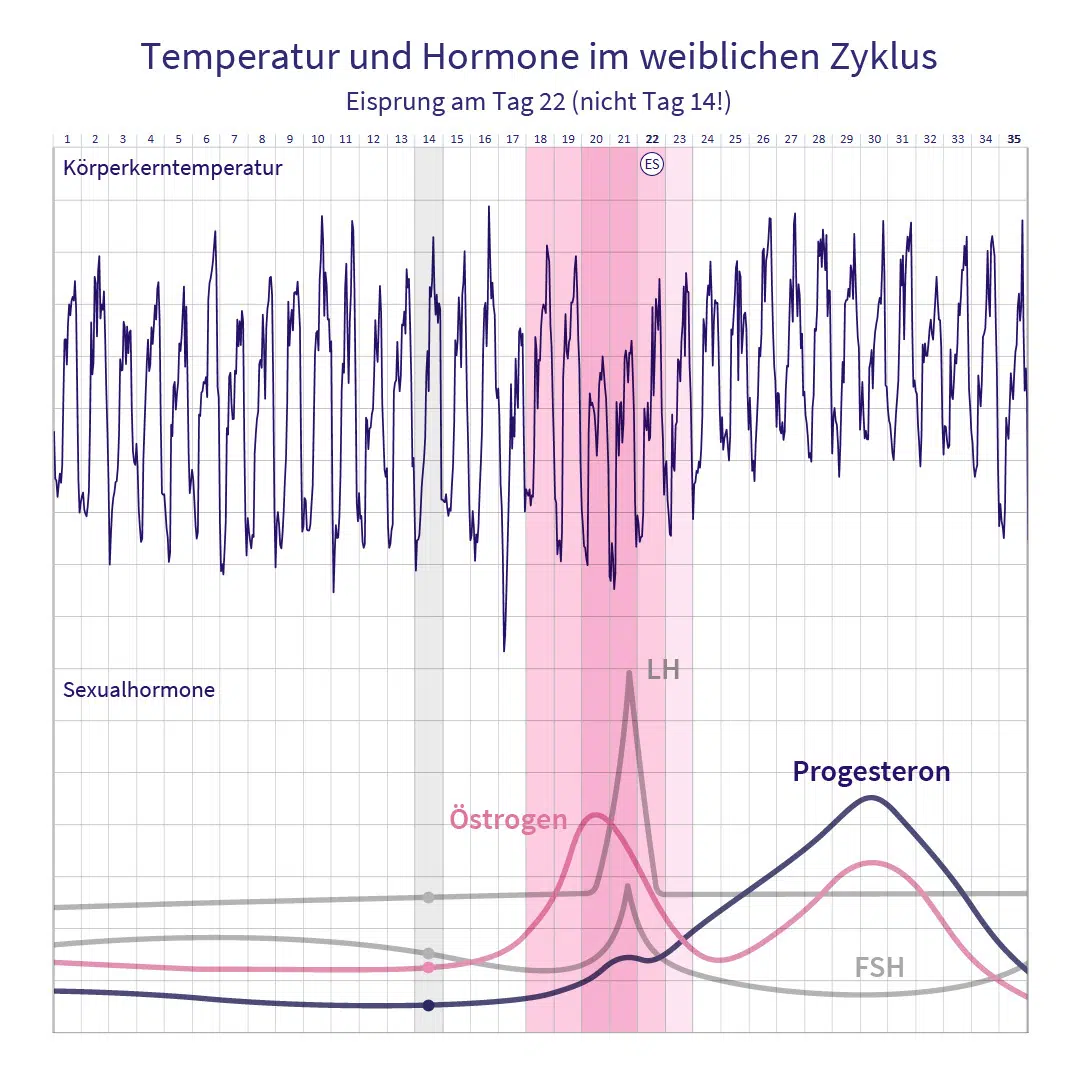
As is well known, temperature can be measured in the mouth, in the ear, under the armpit, on the skin, rectally, or vaginally. However, each of these methods is subject to different factors. For example, the temperature measured in the ear or on the skin is always lower than that inside the body. Even measurements taken in the mouth or under the armpit can only vaguely reflect the exact temperature changes within the body. In comparison, vaginal measurement provides the most accurate data. This allows for precise conclusions to be drawn about female sex hormones, since changes in body temperature are recorded precisely where the hormones have their most significant effect. Only the temperature at the body’s core (core body temperature) can accurately reflect changes in a woman’s sex hormones!
There are two hormones that significantly influence body temperature around the time of ovulation. One is luteinizing hormone (LH), which causes a brief drop in temperature. The so-called LH surge triggers ovulation. The other is the hormone progesterone, which causes a significant rise in body temperature around the time of ovulation. The body’s hormonal system has a certain reaction time. This means that changes in hormone levels take effect gradually in the body. Recent research also shows that hormones do not act uniformly but follow specific patterns in the body. This is also the reason why Traditional ovulation tests are not sure how to determine ovulation.
When ovulation occurs, it is reflected in certain characteristics of the rise in body temperature. The brief drop in body temperature mentioned earlier, caused by the LH surge, is not clearly present in every cycle. The situation is different with the temperature rise caused by progesterone. If the average body temperature rises by at least 0.2 °C over a period of at least 3 days, this indicates ovulation.
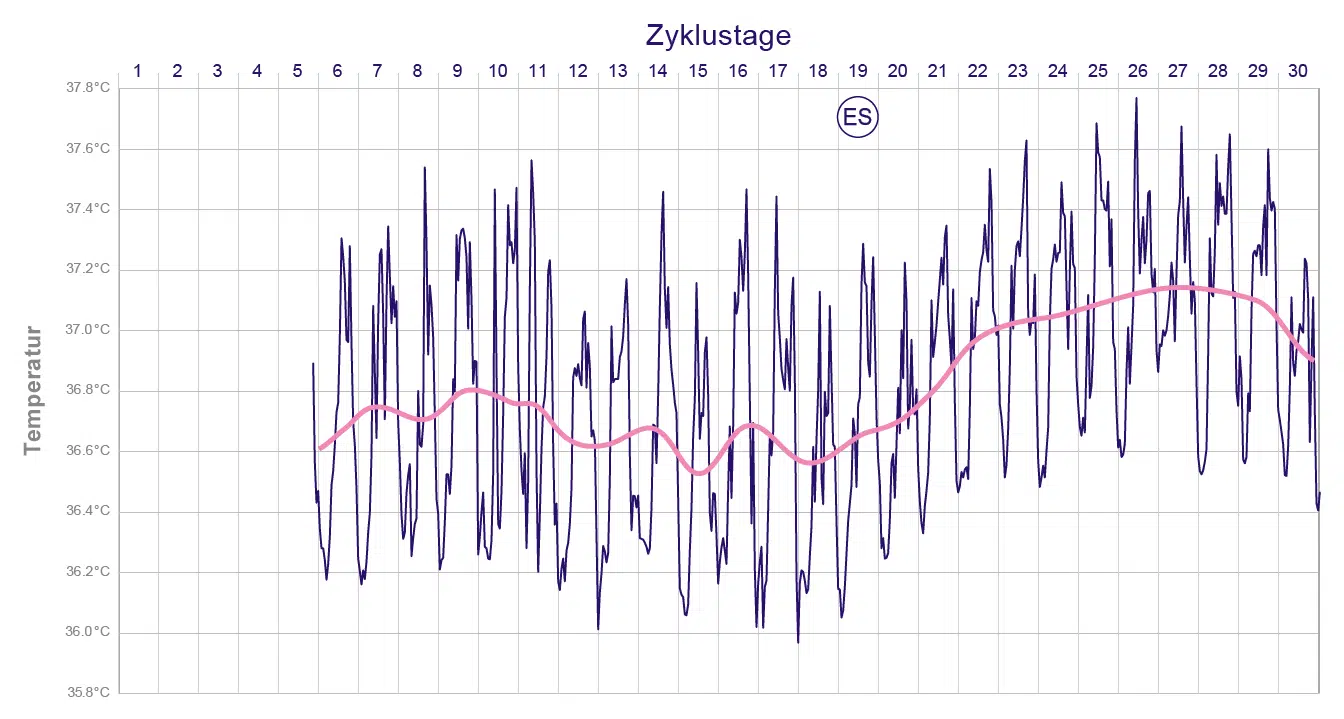
In addition to the rise in temperature itself, it is also important to consider how long the temperature remains elevated. The duration of the elevated temperature reflects the quality of the progesterone. If the temperature drops again before the second phase of the cycle has lasted 10 days, this is referred to as a Luteal insufficiency. In this case, there is a rise in temperature, but the ovary does not produce enough progesterone. Conception is not possible in this case because there is no fertile days are available.
What might be standing in the way of your dream of having a baby—and what you can do to get pregnant faster!
OvulaRing is a medical method for accurately calculating your ovulation and determining your fertile days. The patented method, which uses a vaginal temperature sensor, is suitable for everyone Cycle Types suitable. OvulaRing is a certified medical device that comes with an app and is as easy to use as a tampon.
OvulaRing was developed by gynecologists and has undergone extensive clinical testing. Using a vaginal biosensor, OvulaRing automatically tracks your core body temperature around the clock—without the hassle of taking your temperature every morning. Instead of a single data point, OvulaRing records 288 data points per day, allowing it to track your cycle much more accurately, regardless of cycle length and external factors such as stress, sleep, exercise, or diet.
Medical algorithms analyze the data and identify your individual Menstrual and Fertility PatternsWith OvulaRing, you can find out whether you’re ovulating or if there are signs of a hormonal cycle disorder. You can also view your daily probability of conception and a forecast for ovulation in the next cycle.
By measuring your basal body temperature in the morning, you can generally determine when ovulation has occurred. To do this, you must always take your temperature at the same time and in the same place; otherwise, the results will be of little use.
The data is then transferred to a cycle chart, a cycle app, or a cycle computer. The results are plotted on a cycle chart for a clearer overview. Here you can see when the temperature rises. If the temperature remains elevated for at least 3 days, ovulation has most likely occurred.
Determining ovulation by measuring basal body temperature is time-consuming and, unfortunately, prone to error. To ensure accurate results, you should get the same number of hours of sleep every night. An irregular lifestyle, shift work, travel, alcohol consumption, and stress can interfere with the measurement. Restless sleep—caused, for example, by children waking up, going to bed late, or irregular wake-up times—also directly affects measurement accuracy. The results can be easily skewed. Furthermore, women often feel stressed when they think about the morning measurement and are afraid of missing the right time. Therefore, this method of ovulation tracking is only suitable for very disciplined women with a regular lifestyle and a relatively regular cycle.
By measuring your basal body temperature, you can only determine when ovulation occurred after the fact. However, to get pregnant, you need to be able to track the time leading up to ovulation! The chances of conception are highest about 2 days before ovulation. Relying solely on basal body temperature measurements means you’ll miss these crucial days. Many women therefore also monitor their cervical mucus, which changes even before ovulation. Determining your fertile days using cervical mucus requires a lot of experience. Many women find it difficult to interpret cervical mucus in a way that reliably identifies their fertile days.
With OvulaRing, we’ve improved and simplified temperature tracking. You don’t have to remember to take your temperature in the morning, nor do you have to record or interpret your readings. By taking continuous readings every 5 minutes, OvulaRing provides accurate results even with irregular cycles and lifestyles. Your temperature changes slightly even before ovulation. OvulaRing detects these changes and shows you when you’re most likely to get pregnant.
An ovulation test measures the level of luteinizing hormone (LH) in the urine. LH is released in greater quantities during the fertile phase and, in a healthy cycle, triggers ovulation through a sudden surge. LH is excreted in the urine. An ovulation test can then measure the concentration of LH in the urine. The test reacts to the rise in ovulation-triggering LH in the urine. Until now, it was assumed that the highest LH concentration, known as the LH surge, is reached about 24–36 hours before ovulation. So much for the theory. But be careful! An ovulation test that measures LH in the urine cannot determine your ovulation date with exact precision.
Scientists have demonstrated that a rise in LH levels in urine is not always followed by ovulation. On average, the LH peak occurred 1.2 days after ovulation, rather than before it, as previously assumed. In only 6% of cycles did the LH surge end before ovulation. In the overwhelming majority (94%), however, LH continued to rise after ovulation, and in 60% of cycles, it rose for even longer than 3 days.
To conceive, it is especially important to determine the time before ovulation, since the egg survives for only about 12 to 24 hours. In many cases, however, the LH test does not show a positive result until it is already too late for the egg to be fertilized.
Ovulation tests are also unsuitable for hormonal cycle disorders such as PCOS or early menopause. In these cases, LH levels are often persistently elevated, causing the ovulation test to remain consistently positive. For example, elevated LH levels are observed in 60% of all women with PCOS. Accurately determining ovulation is therefore often not possible with an ovulation test! Women with long cycles need a large number of ovulation tests. Daily hormone testing is thus not only time-consuming, but also nerve-wracking and expensive!
Your LH levels can fluctuate significantly even over the course of a normal day. In addition, taking antibiotics, psychiatric medications, or hormone therapy, as well as conditions affecting the liver, kidneys, or ovaries, can affect the reliability of the LH test. Whether positive or negative, the LH test isn’t always clear-cut, and many women have to “guess.” Individual differences in LH levels, as well as the sensitivity of the specific test system, influence the result.
Testing hormone levels in urine alone is based on just one measurement per day and does not provide a complete picture of your cycle.
It’s nearly impossible to get a complete picture of your individual cycle without continuous tracking. If you’re trying to get pregnant, don’t rely on inaccurate ovulation tests! OvulaRing measures your core body temperature around the clock, stores 288 data points per day, and reliably indicates your fertility window and ovulation, regardless of how long your cycle is or whether you have a hormonal cycle disorder.
There are a wide variety of cycle trackers and calculators available on the market. Some determine your fertile days by measuring your temperature—for example, on your arm, wrist, or vaginally. Others measure the LH level in urine, the progesterone level in saliva, or changes in exhaled breath caused by hormones. With some, you see your fertile days displayed in an app; with others, they appear on the device itself.
No matter what type of tracker or computer you’re using, they all have the following in common: they rely solely on a single daily reading or an overnight measurement. This makes them prone to error and unable to continuously track your cycle. They cannot provide you with comprehensive information about your cycle health. All products available on the market are designed and tested only for standard cycles. 70% of all women whose cycles do not conform to the standard do not receive accurate information about their ovulation and fertility from these tools.
If you’re trying to get pregnant, it’s important not only to track your ovulation but also to keep an eye on your overall cycle health. This is only possible with continuous cycle monitoring. OvulaRing automatically measures your basal body temperature every 5 minutes—24 hours a day, 7 days a week. That’s why OvulaRing can identify your fertile days even if your cycles are extremely short, very long, or completely irregular. Additionally, OvulaRing can help you determine whether there are signs of a hormonal cycle disorder despite ovulation. Unlike other products on the market, OvulaRing has been tested in three independent medical studies on women with a wide variety of cycles and hormonal cycle disorders, and is suitable for them as well for determining fertile days.

The most important part of your cycle is your fertile window. However, this can only be accurately determined if ovulation is pinpointed. The OvulaRing method for measuring core body temperature allows you to track your cycle with great precision. Based on the many readings, OvulaRing can identify your unique cycle patterns and calculate your ovulation date with precision.
Ovulation can be accurately calculated based on the body’s core temperature. This hormonal change in temperature follows a pattern that is typical for each woman. The clearest sign that ovulation has occurred is a rise in body temperature of more than 0.2 °C. However, this does not necessarily mean that, exactly when ovulation occurs!
To accurately determine the time of ovulation, OvulaRing analyzes the pattern of the rise in temperature. In addition, the OvulaRing data tracking and ovulation detection system is patented and approved as a medical device. Furthermore, the accuracy of this method of cycle tracking has been demonstrated in several medical studies.
OvulaRing calculates your ovulation date with great precision for each of your cycles. By comparing your different cycles and using medical algorithms, OvulaRing can identify additional individual fertility patterns. These are not as noticeable to the naked eye as the distinct rise in temperature caused by progesterone. Based on this information, OvulaRing can determine your fertility on a daily basis, even if you haven’t ovulated yet.
Several health insurance providers help cover the cost of the OvulaRing. You can find all the information here.
With irregular cycles, it is not possible to reliably “predict” ovulation. Basic rule: Ovulation occurs about 12–16 days before your next period – but since the next period varies, ovulation also varies.
Practical procedure: Keep track of physical signs (cervical mucus, basal body temperature), use LH tests if necessary, and collect data over several cycles. For very long cycles (>(35–40 days) or if you are trying to conceive without becoming pregnant, it is advisable to seek medical advice.
Yes. You can:
Basal body temperature (BBT) Measure: After ovulation, it rises by ~0.2–0.5 °C and remains elevated until your period (confirming ovulation in retrospect).
Cervical mucus Observe: Shortly before ovulation, it becomes clear, stretchy, and “egg-white-like” (Note before (around the time of ovulation).
Physical signs How to document menstrual pain (nonspecific).
Medically, ovulation and the rise in progesterone can be determined by Ultrasound or Progesterone blood level confirm (based on practical experience).
Apps are only as good as the Data and Methodology behind it.
Pure Calendar apps are based on past cycles and work particularly well with regular Cycles.
Apps that biomarker (temperature, cervical mucus, and sensor-based data) can provide a more personalized picture of fertile days.
Important: Forecasts remain Estimates – The more variable the cycle, the greater the deviation.
The fertile window includes about 6 days: the 4 days before ovulation, the Day of ovulation and the The day after ovulation. Reason: Sperm can survive in the body up to 5 days survive; the egg is released after ovulation 12–24 hours fertile.
The best chance is 1–2 days before ovulation.
With PCOS, periods are often extended or anovulatory, and LH-Tests can be caused by frequently elevated LH levels false positive be canceled.
A better option is a Combination based on long-term temperature trends, cervical mucus observation, and—if necessary— under medical supervision (Ultrasound/progesterone). If ovulation is not detected over several months or if you are trying to conceive, please consult a gynecologist.
BBT measurement is required consistent measurement conditions (after at least 3–4 hours of sleep, right after waking up). Shift work often disrupts this.
Tips:
If BBT: always when you first wake up measure and document interfering factors.
Cervical mucus monitor as well.
LH-Tests Start after your usual sleep/wake time (not strictly “in the morning”).
Continuous, sleep-independent measurement methods may be more helpful for shift work.
Source: Apotheken-Umschau – Luteinizing hormone
Join our newsletter and get your 10% discount for your starter package. Enter your email to continue.
You are currently viewing a placeholder content from Facebook. To access the actual content, click the button below. Please note that doing so will share data with third-party providers.
More InformationYou are currently viewing a placeholder content from Instagram. To access the actual content, click the button below. Please note that doing so will share data with third-party providers.
More InformationYou are currently viewing a placeholder content from Newsletter2Go. To access the actual content, click the button below. Please note that doing so will share data with third-party providers.
More InformationYou are currently viewing a placeholder content from Trustpilot. To access the actual content, click the button below. Please note that doing so will share data with third-party providers.
More InformationYou are currently viewing a placeholder content from X. To access the actual content, click the button below. Please note that doing so will share data with third-party providers.
More Information