

The interaction of algorithms
The data collection and accuracy of OvulaRing are ensured by the interaction of highly complex algorithms, which enable reliable assessments of past and current fertility,...
Von:
Anne Alexander
Last reviewed:

The data collection and accuracy of OvulaRing are ensured by the interaction of highly complex algorithms, which enable reliable assessments of past and current fertility, as well as predictions of the fertile and infertile phases of the female cycle. When these functions mesh together like gears, a valid assessment of a woman’s fertility status and cycle health—past, present, and future—can be made. Each function on its own already contains valuable information and is of great importance for the dynamic and flexible interlocking of these “cogs.”
Overview of OvulaRing’s Algorithms
The Retrospective – The Past
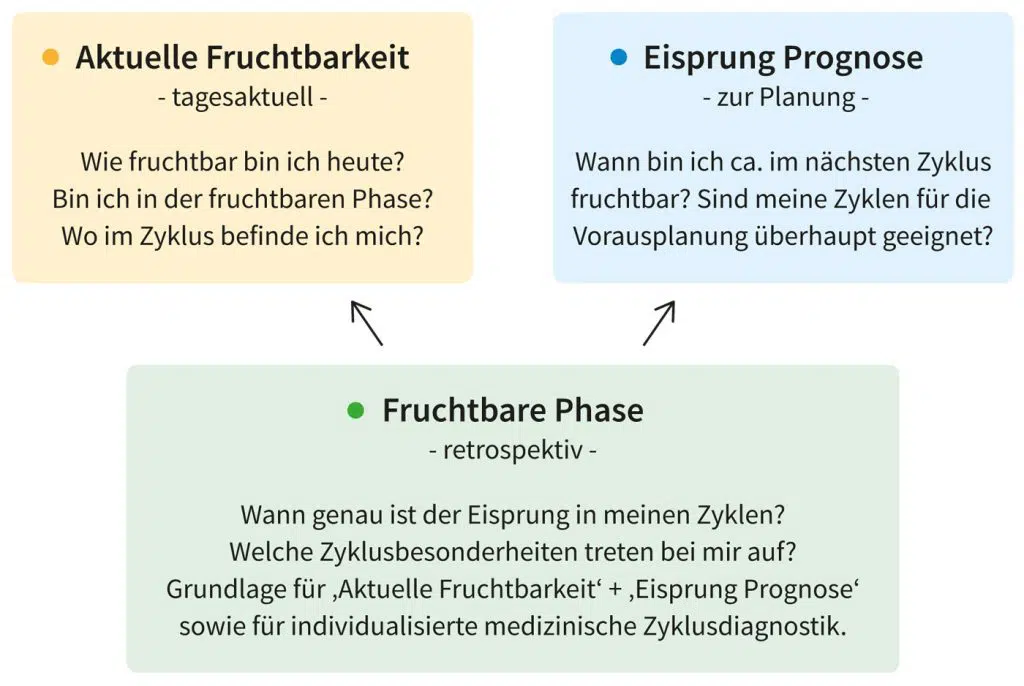
The collection of retrospective data forms the basis of the data set and is crucial for refining the current probability of conception and the prediction function. The larger this data set, the more accurately the algorithms can calculate the probabilities of fertile and infertile phases, both in real time and in advance. A minimum of 2–3 recorded cycles using OvulaRing is required for this. In the first cycle, OvulaRing learns the woman’s individual patterns. By the second cycle, a real-time assessment of fertility status can already be made. After 3 recorded cycles with ovulation, a forecast of future conception probabilities is generated, including a calculated ovulation date. Only the collected data enables reliable future planning. In other words: The future can only be planned based on the past. This offers significant added value for both those hoping to conceive and those seeking natural contraception. The retrospective data is also of central importance for the integrated cycle statistics in the myovularing.com software. Here, all recorded cycles can be clearly compared with one another, including a summary of the respective length of the second half of the cycle, the day of ovulation, and the average basal body temperature. Through this retrospective analysis, it is possible not only to determine whether ovulation occurred in the previous cycle but also whether that cycle was healthy. The length of the second half of the cycle also allows for individualized diagnosis. The evaluation of retrospective cycles is, not least, a crucial foundation for personalized fertility treatment.
Current Fertility – Present
The Current Probability of Conception feature indicates whether the user’s probability of conception is low, medium, or high at the moment she reads her data. This is based on individual core body temperature patterns that were learned during the previous cycle and are analyzed in the subsequent cycle. Biomarkers in the core body temperature patterns allow the current probability of conception to be calculated in detail and with precision. The wealth of data collected to date from past OvulaRing cycles is incorporated into the calculation. The calculation of probabilities is always dependent on the data set. The Current Probability of Conception indicates how fertile the user is today, whether she is in her fertile phase, and exactly where she is in her cycle. This knowledge is essential both for those hoping to conceive and for supporting natural contraception. Furthermore, women are not solely at the mercy of their bodies and can better interpret and understand their physical signs and mood swings.
The Outlook – The Future
The prediction feature allows OvulaRing users to assess the reliability of their planning regarding future fertile phases and upcoming ovulations. This feature is particularly important for planning pregnancy or natural family planning. Is reliable planning possible or not? This requires a minimum of 3 cycles recorded with OvulaRing. The more cycles that have been recorded, the higher the probability of pattern recognition. The probability of conception in future cycles correlates with the previously recorded cycles. If the previous cycles are biphasic, ovulatory, and healthy, the probability of a subsequent healthy biphasic cycle is higher. If the previous cycles are monophasic, the probability of anovulation in the subsequent cycle also increases. If the ovulation dates from previous cycles vary by more than 8 days, predictability and a reliable prognosis for the subsequent cycle can no longer be provided. The menstrual cycle is a highly complex biological process and is very individual for every woman. However, with the help of the current probability of conception and the retrospective analysis of cycles, the user can always see which phase of the cycle she is currently in and whether she has ovulated in past cycles.
With OvulaRing, vast amounts of temperature data are measured completely unnoticed, with up to three-digit accuracy. Various algorithms link this wealth of core body temperature data around the clock to provide insights into past trends, current conception probability, and future projections. This seamless integration and interaction of the individual OvulaRing functions gives the user a comprehensive overview of her cycle activity in the past, present, and future. Nevertheless, each function, when viewed individually, is also highly informative for both the user and the physician. By consolidating all core body temperature readings, the system not only provides significant insights into a woman’s fertility probability and cycle health but also enables personalized fertility diagnostics and infertility treatment.