
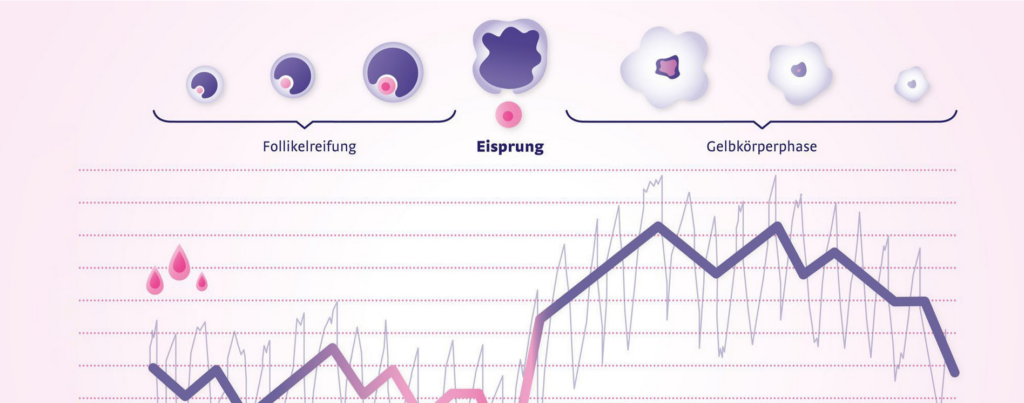
Luteal insufficiency – also known as luteal insufficiency – occurs when the second phase of the menstrual cycle (Luteal phase) is too short or progesterone levels are too low. Typical signs include spotting before your period or a shortened high-temperature phase (luteal phase) < (11 days). Find out here how to interpret symptoms correctly, when it makes sense to take a test, and what role basal body temperature plays.
For those hoping to have children This means: closely monitoring your cycle and the length of the luteal phase, determining the right time for a progesterone test—and, if necessary, considering treatment after ovulation.
After ovulation, the corpus luteum forms during the second half of the menstrual cycle and produces the hormone progesterone. In cases of luteal insufficiency, the corpus luteum does not develop properly, resulting in lower levels of progesterone. However, this hormone is essential for the development of the uterine lining and the implantation of the embryo.
Corpus luteum insufficiency, also known as progesterone deficiency, can be caused by various hormonal imbalances. Psychological and physical stress, very intense physical activity, and being underweight or overweight often play a role.
In addition to lifestyle factors, hormonal conditions such as PCOS or thyroid disorders can also contribute to a shortened luteal phase.
Age and natural changes in the menstrual cycle can also play a role. As the menstrual cycle matures or due to age-related hormonal changes, fluctuations in progesterone production are not uncommon.
A key characteristic is a shortened second phase of the menstrual cycle lasting less than 11 days. Spotting often occurs one to three days or more before menstruation.
A common finding is a shortened or flat hyperthermic phase in the basal body temperature curve, which drops too early or lasts for fewer than 10–11 days.
Low progesterone levels are typical during the luteal phase. Important: The test should be performed five to seven days after ovulation—otherwise, the results may appear normal when they are not.
Luteal phase deficiency can lead to very early miscarriages and make it difficult for the embryo to implant, even if ovulation occurs. Some women also report severe PMS, breast tenderness, or fatigue.
Note: A single instance of a short luteal phase is often not a cause for concern. What is significant is a recurring pattern over several cycles. Your gynecologist should conduct the evaluation and provide treatment.
The diagnosis is made by the Confirmation of ovulation and a Progesterone measurement 5–7 days after ovulation (OV+7). A low progesterone level may indicate a shortened or unstable luteal phase. In addition, the Temperature curve useful information—such as an altitude that is too low or a flat temperature rise.
Learn more about the self-assessment & You can find the typical signs here:
Treatment for luteal insufficiency always depends on the underlying cause. If a doctor detects low progesterone levels, they will often prescribe a Progesterone replacement after ovulationto prolong the luteal phase and better prepare the uterine lining for potential implantation.
In addition, Lifestyle factors how stress, sleep quality, diet, or extreme body weight can affect the luteal phase. Even small changes in daily life can sometimes help improve hormonal balance.
Everything You Need to Know About Medical Options & You can find natural remedies here:
After ovulation, the corpus luteum from the follicle and primarily forms Progesterone. This leads to the typical rise in temperature (≈0.3–0.5 °C) and prepares the uterine lining for implantation.
In a normal biphasic cycle, the luteal phase lasts 11 to 15 days. In cases of luteal phase deficiency, it is typically shorter.
The 0.3–0.5 °C rise in temperature triggered by progesterone marks the hyperthermic phase. If this phase is too short, implantation becomes more difficult.
Recognize more patterns: Cycle with luteal phase deficiency
Progesterone helps build up the uterine lining and maintain a pregnancy. Without sufficient levels, implantation is difficult.
Blood progesterone levels should be measured in the middle of the luteal phase. If measured too early or too late, the results are often not reliable.
If progesterone is taken before ovulation, it acts like a mini-pill and prevents ovulation. That is why timing is crucial.
It is a possible cause of infertility, but it is less common than is often assumed.
Usually 11–17 days. Repeatedly shorter cycles may indicate luteal phase deficiency.
An abnormal temperature curve or spotting are signs—only a doctor can provide a definitive diagnosis.
Yes, pregnancy is possible. However, implantation may be difficult. With personalized diagnosis and treatment, the chances of success increase significantly.
Typical signs include a second half of the cycle lasting less than 11 days, spotting before menstruation, or unusual temperature patterns.
Progesterone can be helpful if a deficiency has been diagnosed. It should be taken after ovulation, and the dosage should be tailored to the individual.
Luteal phase deficiency refers to a shortened luteal phase. Progesterone deficiency is the underlying hormonal cause. Although the two terms are often used interchangeably, they are not identical.
Elternsein beginnt nicht erst mit der Geburt. ❤️ Sondern oft schon mit einem Wunsch, der alles verändert.
Zum Mutter- & Vatertag schenken wir euch 75€ auf alle OvulaRing Pakete
mit dem Code
WISH75
gültig nur bis 17.5.2026
Join our newsletter and get your 10% discount for your starter package. Enter your email to continue.
You are currently viewing a placeholder content from Facebook. To access the actual content, click the button below. Please note that doing so will share data with third-party providers.
More InformationYou are currently viewing a placeholder content from Instagram. To access the actual content, click the button below. Please note that doing so will share data with third-party providers.
More InformationYou are currently viewing a placeholder content from Newsletter2Go. To access the actual content, click the button below. Please note that doing so will share data with third-party providers.
More InformationYou are currently viewing a placeholder content from Trustpilot. To access the actual content, click the button below. Please note that doing so will share data with third-party providers.
More InformationYou are currently viewing a placeholder content from X. To access the actual content, click the button below. Please note that doing so will share data with third-party providers.
More Information