Basal Body Temperature Measurement
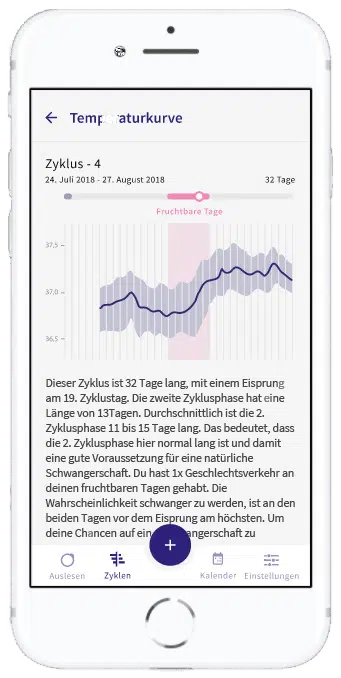
Your temperature reflects the hormonal changes in the female cycle. At the time of ovulation, the simultaneous release of the hormone progesterone causes your core body temperature to rise by 0.25 to 0.5°C. By measuring your morning wake-up temperature, also known as your basal body temperature, you can determine when ovulation has occurred. To do this, you must always take the measurement at the same time and in the same place. The most accurate temperature is your core body temperature, which can be measured orally, vaginally, or rectally. The data is then entered into a cycle chart, a cycle app, or a cycle computer. The results are plotted on a cycle chart, allowing you to see when the temperature rises. If the temperature remains elevated for at least 3 days, you can be sure that ovulation has occurred.
Determining ovulation by measuring basal body temperature is time-consuming and prone to error. For accurate results, you should have slept for the same number of hours each night. In particular, an irregular lifestyle, shift work, travel, alcohol consumption, stress, and restless sleep—e.g., due to children waking up, going to bed late, etc.—directly affect measurement accuracy and can very easily skew the results. Additionally, women often feel stressed when they think about taking their morning temperature and are afraid of missing the right time. Therefore, this method of ovulation tracking is only suitable for very disciplined women with a regular lifestyle and a relatively regular cycle.
Recording core body temperature
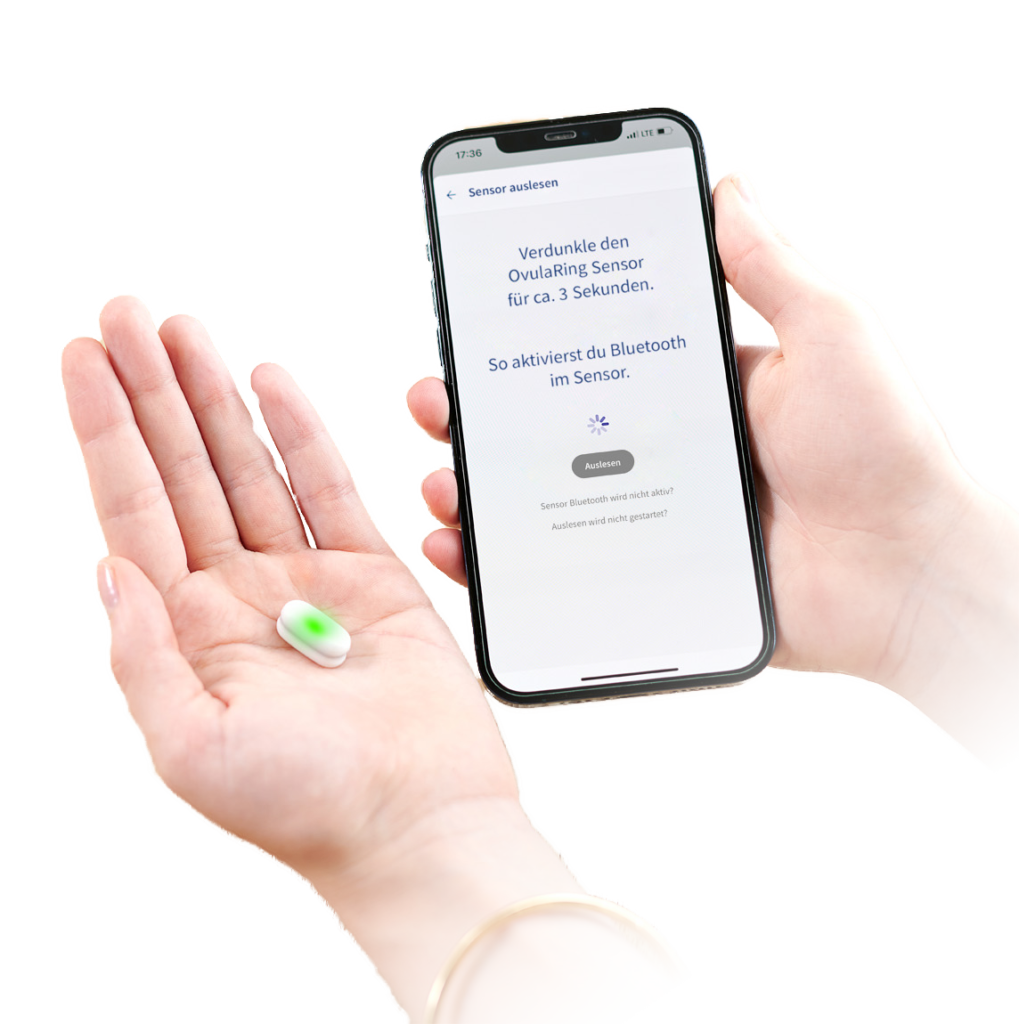
With OvulaRing, we have objectified and simplified temperature measurement. You no longer have to think about taking your morning temperature, transferring temperature readings, or interpreting temperature charts. With high-resolution measurements every 5 minutes, 288 times a day, OvulaRing delivers precise results even with irregular cycles and lifestyles. Your temperature changes slightly even before ovulation. OvulaRing detects these changes and shows you when your chances of getting pregnant are highest.
Ovulation or LH Tests
An ovulation test measures the level of luteinizing hormone (LH) in urine. It is released in greater quantities during the fertile phase and, in a healthy cycle, triggers ovulation through a sudden surge. LH is excreted in the urine. An ovulation test can then measure the concentration of LH in the urine. The test reacts to the rise in ovulation-triggering LH in the urine. Until now, it was assumed that the highest LH concentration, the so-called LH surge, is reached about 24–36 hours before ovulation. So much for the theory. But be careful! An ovulation test that measures LH in urine cannot determine your ovulation exactly.
Ovulation tests do not accurately reflect your cycle
Scientists have shown that an LH surge in urine is not always followed by ovulation. On average, the LH peak occurred 1.2 days after ovulation, not before as previously assumed. In only 6% of cycles did the LH surge end before ovulation. In the overwhelming majority (94%), however, LH continued to rise after ovulation, and in 60% of cycles, it remained elevated for more than 3 days. Ovulation tests are also unsuitable for hormonal cycle disorders such as PCOS or during the onset of menopause. In these cases, the LH level is often persistently elevated, so the ovulation test frequently remains positive throughout. For example, elevated LH concentrations can be observed in 60% of all women with PCOS. Accurately determining ovulation with an ovulation test is therefore often impossible!
Women with long cycles need a large number of ovulation tests. Daily hormone testing is thus not only time-consuming but also nerve-wracking and expensive! Your LH levels can fluctuate significantly even over the course of a normal day. Additionally, taking antibiotics, psychotropic medications, hormone therapy, or Hormone testing in urine alone is based on a single measurement point per day and does not provide a comprehensive overview of your cycle. To fully understand your individual cycle, continuous cycle monitoring is essential. OvulaRing measures your core body temperature around the clock, records 288 data points per day, and reliably indicates your fertility window and ovulation, regardless of how long your cycle is or whether you have a hormonal cycle disorder.
Cycle trackers and cycle computers
There are a variety of different cycle trackers and computers on the market. Some determine fertile days using temperature, e.g., on the arm, wrist, or vaginally. Others measure LH levels in urine, progesterone levels in saliva, or hormonal changes in exhaled breath. With some, your fertile days are displayed in an app; with others, they appear on the device itself.
No matter what type of tracker or computer you use, they all have the following in common: They rely solely on a single daily measurement or an overnight reading. This makes them prone to error and unable to continuously track your cycle. They cannot provide you with comprehensive information about your cycle health. All products available on the market are suitable and tested only for standard cycles. 70% of all women whose cycles do not conform to the standard do not receive accurate information about their ovulation and fertility from these tools.
Determine your cycle health
If you want to know whether your cycle is healthy, it’s not just important to track your ovulation but to keep an eye on your overall cycle health. This is only possible with continuous cycle monitoring. OvulaRing automatically measures your core body temperature every 5 minutes—24 hours a day, 7 days a week. For this reason, OvulaRing detects your fertile days even if your cycles are extremely short, very long, or completely irregular. Additionally, with OvulaRing, you can determine whether there are signs of a hormonal cycle disorder despite ovulation. And unlike other products on the market, OvulaRing has been tested in three independent medical studies on women with a wide variety of cycles as well as hormonal cycle disorders, and is suitable for them to determine their fertile days.