Long cycle

What are the characteristics of long cycles?

Determining ovulation in women with long cycles

Ovulation occurs even during long cycles

Even very long cycles are generally healthy and involve ovulation. However, with long cycles, it is somewhat more difficult to determine the exact day of ovulation. The old Faust formula, which states that ovulation should occur in the middle of the cycle, does not apply here at all! Instead, ovulation typically occurs after the 20th day of the cycle, and in some cases even much later.

Even with extremely long cycles, OvulaRing shows you whether you’re ovulating and, if so, when it’s happening.

What causes long cycles?

For women with long cycles, the first phase of the cycle is often prolonged. This means that the egg maturation or follicular phase is significantly longer than the luteal phase. Nevertheless, 70% of all women with very long cycles still ovulate and have fertile days. So, in principle, you can still get pregnant with a long cycle. For the remaining 30%, the cycles either lack ovulation entirely (monophasic) or involve luteal phase or progesterone deficiency. In the latter case, the second half of the cycle is shorter than 10 days. In this situation, insufficient progesterone is released, and pregnancy cannot occur.

With OvulaRing, you can determine exactly whether you’re ovulating even if you have long cycles. OvulaRing tells you whether ovulation is occurring during your cycles. This also helps you determine whether you have a progesterone deficiency, for example.

OvulaRing helps you accurately identify your fertile days

OvulaRing detects ovulation with over 99% accuracy. Finally, get clarity on whether you ovulate regularly and, if so, when. OvulaRing automatically and completely tracks your cycle without you even noticing. This makes it possible to detect even the slightest fluctuations.

OvulaRing has been tested in independent clinical studies for all cycle types. Even with very long cycles, it provides you with accurate information about your fertile days and your cycle health.

These women became pregnant despite having long cycles

Order OvulaRing now

Take control of your fertility now and get to know your cycle better. Find out when ovulation occurs during your menstrual cycle and when your fertile days are.

from €44 per month

How OvulaRing Works

1. Wear the OvulaRing

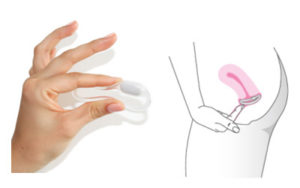
OvulaRing - flexibler Kunststoffring und Biosensor - so einfach anzuwenden wie ein Tampon

Once your period has ended, OvulaRing is inserted into the vagina like a tampon. Regardless of external factors, it automatically records your temperature inside your body. A reading is taken every 5 minutes, allowing your individual fertility patterns to be identified.

2. Transfer data

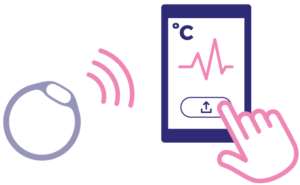
OvulaRing Datenübertragung - Bluetooth Sensor einfach über smartphone auslesen

The recorded data is easily transferred using the OvulaRing app. The app also displays an analysis of your cycles. You can keep a cycle diary and receive important information. The security of your data is our top priority.

2. Evaluate the cycle

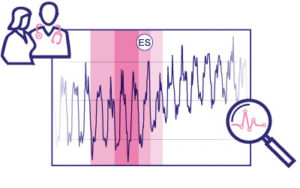
Temperaturkurve des weiblichen Zyklus - Ovularing Auswertung

The app uses medical algorithms to analyze your cycle. In addition to cycle length, ovulation day, and the duration of each phase of your cycle, it also provides medical insights. It offers a daily updated probability of conception as well as an ovulation forecast for the following month.

Benefits of modern cycle tracking with OvulaRing

Suitable for all cycle types

Is your cycle super short, extremely long, or even very irregular? OvulaRing tracks your personal cycle, no matter what Cycle type you are. The OvulaRing method works for all types of cycles. This has also been confirmed in three medical studies covering a wide variety of cycle types.

Continuous measurement

With traditional basal body temperature tracking, you don’t measure your temperature continuously, but only once a day. To analyze your personal cycle even more accurately, however, OvulaRing measures around the clock and records 288 data points daily. This provides much more information for pinpointing your fertile days. OvulaRing also recognizes your very own cycle pattern and provides you with accurate results.

Practical and barely noticeable

OvulaRing is just as easy to use and feels even less noticeable than a tampon. When you wear OvulaRing, you can go about your daily life just as you always have. For example, you can exercise or go to the sauna. You can still have sex and enjoy your life. The automatic measurement inside your body always provides accurate results. It doesn’t matter what your daily routine looks like—the measurement works regardless.

Cycle analysis and real-time results

OvulaRing can reliably tell you whether you’re ovulating. This helps you determine whether your cycles are healthy. The app starts by learning your unique cycle patterns in detail. Once your cycle patterns have been identified, it provides you with a daily update on your fertility status. How OvulaRing Works.

Developed by gynecologists and clinically tested

OvulaRing was developed by renowned gynecologists at the University Women’s Hospital in Leipzig. As a result, the method is based on 40 years of experience and scientific research. In addition, OvulaRing is patented and approved as a medical device. Furthermore, the accuracy of this modern method of cycle monitoring has been proven in several medical studies.

Free of hormones and side effects

On the one hand, OvulaRing works entirely without hormones. On the other hand, the ring is also free of plasticizers and side effects. It doesn’t put any strain on your body! In addition, OvulaRing is very comfortable to wear and is as easy to use as a tampon. The material’s excellent tolerability has been confirmed in several medical studies.

Do you have long cycles and still have questions?

OvulaRing customer service

* Maltese NFP Working Group, Natural and safe. The Practical Guide, 2011, p. 29

** L.L. Sievert, C.A. Dubois, Validating signals of ovulation: Do women who think they know, really know?, American Journal of Human Biology, 17:310–320, 2005